
- October 26, 2026
- Clinic Director
- Comment: 0
- Redcord London
Redcord Rehabilitation Before, During and After Menopause: Building Strength, Balance and Mobility
How Redcord NEURAC suspension rehabilitation may help women maintain muscle strength, improve balance and support physical wellbeing through premenopause, perimenopause and postmenopause.
Women’s bodies undergo significant changes throughout adulthood, particularly during the years leading up to menopause and afterwards.
Changes in hormone levels, muscle mass, bone density and body composition can influence physical strength, balance, mobility and everyday comfort.
However, maintaining muscle strength should not begin only when menopausal symptoms appear.
Building strength before menopause, maintaining physical fitness during perimenopause and continuing regular exercise after menopause are all important aspects of long-term musculoskeletal health.
Research increasingly demonstrates that women can improve muscle strength and physical function at every stage.
Redcord NEURAC suspension rehabilitation offers an adaptable approach to strengthening, stability and movement-control exercises that may support women before, during and after menopause.
At The Back Pain Centre in South Woodford, East London, Redcord rehabilitation can be tailored to individual physical abilities and goals.
Understanding the Three Stages of Menopause
Premenopause: Building Strength Before Hormonal Changes
Premenopause refers to the reproductive years before the menopausal transition begins, when menstrual cycles are generally regular.
Although significant menopausal hormonal changes have not yet occurred, age-related changes in muscle mass, physical activity and body composition can still develop.
This makes premenopause an important opportunity to develop and maintain:
Strong muscles supporting the spine and joints
Good balance and coordination
Lower-body strength
Core stability
Physical endurance
Healthy exercise habits
A proactive approach to strengthening may help women maintain the physical capacity needed for an active lifestyle as they grow older.
Importantly, women do not need to be experiencing pain, weakness or menopausal symptoms to benefit from suitable exercise.
Perimenopause: Maintaining Strength Through Change
Perimenopause is the transitional period leading up to menopause.
During this stage, hormone levels fluctuate and menstrual cycles may become less predictable.
Some women experience joint discomfort, disrupted sleep, fatigue, reduced exercise tolerance or changes in body composition.
These symptoms can make maintaining regular physical activity more challenging.
The objective of rehabilitation during perimenopause is to preserve or improve physical function while adapting exercise intensity to individual needs.
Redcord suspension equipment can provide additional body support when necessary, allowing the practitioner to introduce progressively challenging strengthening and stability exercises.
Postmenopause: Supporting Long-Term Physical Independence
Postmenopause begins after menopause, which is generally recognised following 12 consecutive months without menstruation when hormonal contraception is not affecting the assessment.
Following menopause, reduced oestrogen levels can accelerate bone loss and contribute to changes in muscle and body composition.
Maintaining strength, coordination and balance becomes increasingly important for mobility and physical independence.
Regular resistance training remains effective after menopause, and appropriately selected balance exercises may support safer and more confident movement.
What Does Research Tell Us About Strength Training Across Menopause?
A major systematic review published in 2026 examined 126 studies involving 4,019 women.
Researchers found that resistance training significantly improved muscular strength in both premenopausal and postmenopausal women, without a statistically significant difference between the groups.
The review also identified improvements in body composition, including modest increases in functional muscle mass and reductions in fat mass. [3]
Another study published in Medicine & Science in Sports & Exercise examined 70 women aged approximately 40–60 years, divided into premenopausal, perimenopausal and postmenopausal groups.
After a supervised 12-week low-impact resistance exercise programme, the researchers reported:
Approximately 19% improvement in hip abduction strength
Approximately 20% improvement in hip flexion strength
Approximately 12–13% improvement in selected dynamic balance measures
Approximately 2% increase in lean body mass
Improvements in flexibility
Most of these improvements were comparable across the three menopausal groups. [4]
These findings are encouraging because they demonstrate that women retain the ability to improve strength and balance throughout the menopausal transition.
Although these studies did not investigate Redcord specifically, they establish the wider scientific basis for progressive strengthening and functional exercise across menopause.
What Is Redcord NEURAC Rehabilitation?
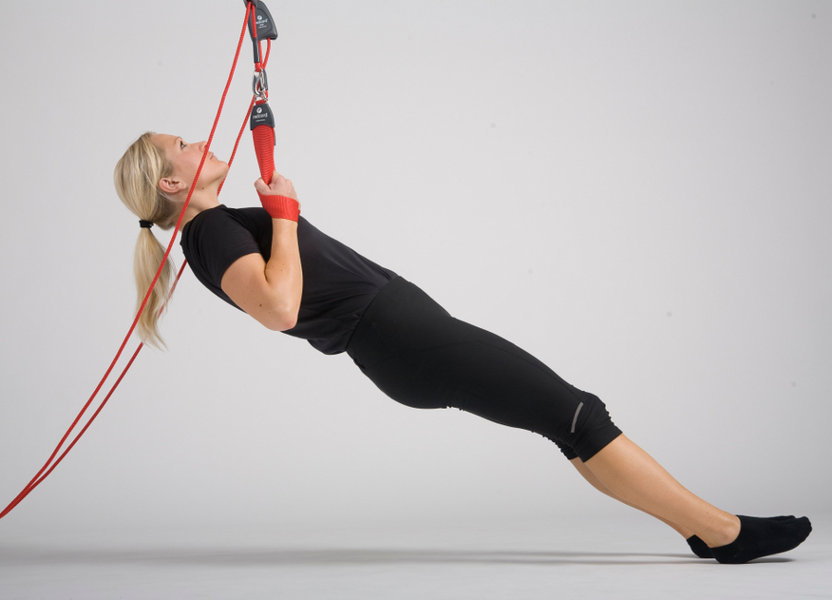
Redcord is a suspension-based rehabilitation system using adjustable ropes, slings and body support.
NEURAC stands for Neuromuscular Activation.
The equipment allows parts of the body to be supported while the person performs controlled exercises.
By adjusting suspension height, body position, resistance and the amount of support, exercises can be adapted to different levels of strength and physical ability.
For example, a woman experiencing muscle weakness may begin with supported exercises that reduce the load on her legs.
As strength and coordination improve, support can gradually be reduced, increasing the amount of muscular work required.
More challenging exercises can also be introduced for women who are already physically active.
Redcord can therefore be used both for rehabilitation and for progressive functional strengthening.
Seven Ways Redcord May Support Women Before, During and After Menopause
1. Developing and Maintaining Muscle Strength
Muscle strength is essential for movement, joint support, physical independence and maintaining an active lifestyle.
During premenopause, strengthening exercises help develop physical capacity and maintain muscle function.
During perimenopause, resistance exercise can help women continue challenging their muscles despite changes in energy levels or exercise routines.
After menopause, appropriately prescribed strengthening exercises remain an important way to address age-related reductions in muscle strength.
Redcord exercises can involve the hips, thighs, shoulders, abdomen, back and other major muscle groups.
A 2011 randomised study compared conventional strength training with sling-based strength training using Redcord equipment in 26 women.
Both groups improved strength over 13 weeks, with sling training producing improvements comparable to conventional resistance exercise. [7]
Although participants were not specifically selected according to menopausal status, the study demonstrates that Redcord can provide an effective form of resistance exercise.
2. Improving Balance and Coordination
Good balance depends on the coordinated activity of muscles, joints, sensory systems and the nervous system.
Balance is important throughout adult life, but maintaining it becomes increasingly valuable with age.
Redcord provides opportunities to practise controlled movements while adjusting how much physical support is available.
Depending on individual ability, exercises may involve supported standing, controlled weight transfers, trunk stabilisation, lower-limb coordination and progressively more demanding balance activities.
A clinical study involving older women found improvements in balance-related measures after six weeks of sling exercises, including functional reach, one-leg standing and Timed Up and Go performance. [8]
These findings support the potential value of suspension-based exercise for balance training.
However, evidence that Redcord specifically prevents falls in menopausal women remains insufficient.
3. Strengthening the Core, Spine and Pelvic Support Muscles
Muscles around the abdomen, spine, pelvis and hips contribute to stability and controlled movement.
These muscles are important when walking, lifting, standing, bending or changing position.
Redcord exercises can challenge the coordination between trunk and limb muscles while allowing external support to be adjusted.
Potential training goals include improving trunk endurance, hip stability, pelvic control and the ability to maintain alignment during movement.
In a randomised clinical trial involving people with osteoporosis, sling-based exercises were associated with improvements in mobility and aspects of physical performance. [9]
For women approaching or experiencing menopause, such exercises may be incorporated into a broader programme of progressive strengthening.
4. Supporting Joint Stability and Movement Control
Joint stability depends not only on the passive structures surrounding joints but also on the strength and coordinated activity of supporting muscles.
Exercises that improve muscular control can be especially relevant for women who experience difficulty controlling movements or who have reduced confidence in particular activities.
Redcord allows practitioners to adjust exercise positions and support while training controlled movement.
This may be useful when working on hip stability, shoulder control, spinal movement or lower-limb coordination.
However, Redcord should not be regarded as a treatment for hormonal joint symptoms simply because they occur around menopause.
Any persistent or unexplained joint pain should be appropriately assessed.
5. Improving Everyday Mobility and Physical Function
Muscle strength and balance are important because they influence ordinary activities.
These include:
Getting up from a chair
Walking and climbing stairs
Carrying shopping
Reaching overhead
Getting down to and up from the floor
Gardening and household activities
Participating in recreational exercise
Redcord can be used to practise movements that require strength and coordination.
For example, supported squats may be introduced before progressing to more demanding lower-limb exercises.
The aim is to improve physical ability in ways that are relevant to daily life.
Clinical research involving patients with osteoporosis has reported improvements in mobility and health-related quality of life following sling-based training. [9]
6. Improving Muscular Endurance and Exercise Confidence
Muscular endurance is the ability to sustain or repeat muscular activity.
It is relevant to walking, standing, maintaining posture and completing everyday tasks without excessive muscular fatigue.
During perimenopause, some women experience disrupted sleep, fluctuating energy levels or reduced motivation to exercise.
A flexible rehabilitation programme may make it easier to continue exercising at an appropriate level.
A small trial published in 2020 investigated eight weeks of TRX suspension training in 40 postmenopausal women.
The researchers reported improvements in muscular endurance and some other measured outcomes. [10]
TRX differs from Redcord, so these results cannot be directly attributed to NEURAC treatment.
Nevertheless, they provide additional evidence that suspension-based resistance training can be incorporated into exercise programmes for postmenopausal women.
7. Supporting Body Composition and General Physical Wellbeing
Changes in body composition are common during midlife, although these are influenced by many factors, including ageing, activity levels, diet and hormonal changes.
Resistance training can help maintain or increase muscle mass.
The 2026 systematic review involving 4,019 women found that resistance training was associated with improvements in muscular strength and body composition across adulthood. [3]
However, Redcord should not be promoted as a weight-loss treatment or as a proven method of reversing menopause-related changes in body composition.
Its principal role is providing adaptable strengthening and movement-control exercises.
Why Start Redcord Training Before Menopause?
One important message from the research is that women should not have to wait until they experience physical decline before beginning strength training.
Premenopause offers an opportunity to establish regular exercise habits and improve muscle strength, coordination and physical fitness.
A 2023 clinical study investigated resistance training in premenopausal and postmenopausal women.
Both groups improved their maximal squat and bench-press strength following training.
Muscle-size improvements were more apparent in the premenopausal group, although this was a relatively small study. [5]
The more recent 2026 systematic review found broadly comparable strength benefits across premenopausal and postmenopausal populations. [3]
The practical conclusion is that progressive resistance training can be beneficial before menopause and remains valuable afterwards.
Redcord may be one suitable exercise option, depending on personal preferences and rehabilitation needs.
Redcord During Perimenopause: Adapting Exercise to Your Needs
Perimenopause can be a particularly variable period.
Some women continue exercising without difficulty, while others experience symptoms that interfere with their normal routines.
For women who find conventional exercises uncomfortable or difficult to control, Redcord suspension support may allow movements to be modified.
A programme may begin with lower levels of resistance or greater physical support.
As ability improves, exercises can become more demanding.
The objective is not simply to make exercise easier but to help the individual perform sufficiently challenging exercises safely and consistently.
Redcord After Menopause: Strength, Balance and Bone Health
After menopause, maintaining bone and muscle health becomes particularly important.
Regular resistance training can help maintain muscle strength, while suitable weight-bearing and impact exercises contribute to bone health.
However, supported Redcord exercises may not provide the same bone-loading stimulus as conventional weight-bearing or progressive resistance exercises.
Therefore, Redcord should not be presented as a proven treatment for osteoporosis or as a substitute for an appropriate bone-health exercise programme.
The Royal Osteoporosis Society recommends progressive strength exercise while taking individual fracture risk and previous injuries into consideration. [12]
Redcord may be used as one component of a broader programme addressing strength, balance and mobility.
Can Redcord Improve Menopausal Symptoms?
Exercise is valuable for general health and physical wellbeing, but there is an important distinction between improving physical fitness and treating menopause itself.
A small study of TRX suspension training reported improvements in selected symptoms, including hot flushes and mood measures, among postmenopausal participants. [10]
However, a major overview published in 2024 concluded that evidence remains insufficient to recommend any particular form of exercise specifically for relieving menopausal symptoms. [11]
Redcord has not been established as a treatment for hot flushes, hormonal changes, night sweats or other menopause-specific symptoms.
It is best understood as a strengthening and functional rehabilitation approach that may help women maintain their physical abilities throughout this stage of life.
What Happens During a Redcord Rehabilitation Programme?
At The Back Pain Centre, the starting point is an individual assessment of physical capabilities and rehabilitation goals.
Depending on the patient’s needs, this may include evaluating:
Muscle strength and endurance
Balance and stability
Core and trunk control
Hip and pelvic function
Functional movement patterns
Joint mobility
Relevant injuries or musculoskeletal complaints
Exercises are selected according to the person’s ability and progressively adapted where appropriate.
For some women, the initial goal may be improving basic strength and confidence with movement.
Others may wish to maintain athletic performance, improve lower-limb stability or develop better trunk control.
Progress can be assessed using suitable functional measures, such as chair-stand performance, balance tests and the Timed Up and Go test.
Redcord rehabilitation may also be combined with conventional strengthening, walking or other physical activities.
UK Chief Medical Officers’ guidance recommends muscle-strengthening activities on at least two days per week, alongside regular aerobic activity. [13]
Is Redcord Suitable for All Women?
Redcord can accommodate different exercise abilities, but not every exercise is appropriate for every individual.
Women with osteoporosis, previous fractures, significant joint problems, severe balance impairment or other relevant medical conditions may require additional precautions.
Exercise programmes should be individually assessed and modified.
Women with possible menopausal symptoms, particularly those experiencing early menopause, should seek appropriate medical advice rather than relying on exercise alone.
Redcord Rehabilitation in South Woodford, East London
At The Back Pain Centre, we provide Redcord NEURAC rehabilitation using specialised suspension equipment.
Our rehabilitation approach focuses on improving physical function through individually selected exercises addressing muscle strength, balance, stability and movement control.
We welcome women who want to improve their physical capabilities during premenopause, perimenopause or postmenopause.
Whether your objective is maintaining strength before menopause, adapting your activity during hormonal changes or improving mobility afterwards, our team can assess whether Redcord rehabilitation is appropriate.
Our clinic welcomes patients from South Woodford, Wanstead, Snaresbrook, Woodford Green, Walthamstow, Chingford, Ilford, Redbridge and surrounding areas of East London.
The Back Pain Centre
50 Chigwell Road
South Woodford
London E18 1LS
Telephone: 020 8989 3338
Contact our team to discuss Redcord rehabilitation or arrange an appointment.
Conclusion: Maintaining Strength at Every Stage of Life
Menopause is an important physiological transition, but it does not mean that muscle weakness or declining physical ability is inevitable.
Research demonstrates that women can improve muscle strength and functional performance before, during and after menopause.
Building strength before menopause, maintaining exercise during perimenopause and continuing appropriate resistance training afterwards can all contribute to long-term physical health.
Redcord NEURAC offers one adaptable method of delivering strengthening, stability and movement-control exercises.
The goal is to help women remain physically capable, confident and active throughout their lives.
Medical disclaimer: This article provides general information about exercise and rehabilitation. Redcord is not a treatment for menopause or hormonal disorders. Individual results vary, and exercise programmes should take account of medical conditions and personal physical ability. Numbered citations correspond to the accompanying research reference list.
Scientific References: Redcord, Resistance Training and the Three Stages of Menopause
1. NHS. What Are Menopause and Perimenopause? (2026)
Official NHS guidance describing perimenopause, menopause and the transition into postmenopause.
Used to establish accurate terminology and distinguish the different stages.
Website: NHS — Menopause and Perimenopause.
2. NICE. Menopause: Identification and Management. NG23. Updated 2024.
NICE recommendation 1.2.5 advises healthcare professionals to explain the importance of maintaining muscle mass and strength through physical activity during menopause.
This provides an important UK clinical recommendation supporting strengthening exercise.
Reference: NICE Guideline NG23.
3. Isenmann E, Geisler S, Havers T, Siegert F, Hemke F, Held S. (2026).
It’s Never Too Late: The Impact of Resistance Training on Strength and Body Composition in Females Across the Lifespan — A Systematic Review and Meta-Analysis.
Journal of Science and Medicine in Sport. 29(10), 1174–1185.
DOI: 10.1016/j.jsams.2026.03.002
PubMed PMID: 41963141.
This systematic review examined 126 studies involving 4,019 women.
Resistance training significantly improved muscle strength in both premenopausal and postmenopausal women.
The researchers found no statistically significant difference between these groups in strength gains.
Improvements in body composition were also reported.
Relevance: Strong evidence supporting progressive resistance exercise both before and after menopause.
This review investigated resistance exercise generally, not Redcord specifically.
4. Svensen E, Koscien CP, Alamdari N, Wall BT, Stephens FB. (2025).
A Novel Low-Impact Resistance Exercise Program Increases Strength and Balance in Females Irrespective of Menopause Status.
Medicine & Science in Sports & Exercise. 57(3), 501–513.
DOI: 10.1249/MSS.0000000000003586
PubMed PMID: 39480197.
A randomised trial involving 70 women categorised as premenopausal, perimenopausal or postmenopausal.
A 12-week low-impact resistance programme produced improvements in hip strength, dynamic balance, flexibility and lean body mass.
The magnitude of most improvements was similar across menopausal stages.
Relevance: Particularly important because the study directly examined all three stages.
The exercise programme did not use Redcord.
5. Isenmann E, Kaluza D, Havers T, et al. (2023).
Resistance Training Alters Body Composition in Middle-Aged Women Depending on Menopause — A 20-Week Control Trial.
BMC Women’s Health. 23, Article 526.
DOI: 10.1186/s12905-023-02671-y
PubMed PMID: 37803287.
Researchers investigated resistance training in premenopausal and postmenopausal women.
Strength increased in both groups. Changes in muscle size were more evident in the premenopausal participants.
Relevance: Supports strength training before menopause while also demonstrating that postmenopausal women can improve muscular strength.
The sample was small, so differences in muscle growth should be interpreted cautiously.
6. González-Gálvez N, Moreno-Torres JM, Vaquero-Cristóbal R. (2024).
Resistance Training Effects on Healthy Postmenopausal Women: A Systematic Review With Meta-Analysis.
Climacteric. 27(3), 296–304.
DOI: 10.1080/13697137.2024.2310521
PubMed PMID: 38353251.
A systematic review of 12 randomised studies.
Resistance training produced significant improvements in upper- and lower-body muscular strength among postmenopausal women.
Relevance: Supports progressive strengthening after menopause.
7. Dannelly BD, Otey SC, Croy T, et al. (2011).
The Effectiveness of Traditional and Sling Exercise Strength Training in Women.
Journal of Strength and Conditioning Research. 25(2), 464–471.
DOI: 10.1519/JSC.0b013e318202e473
PubMed PMID: 21217529.
A randomised study involving 26 women compared traditional resistance exercise with sling training using Redcord equipment.
Both groups improved muscular strength over 13 weeks.
Relevance: Direct evidence for Redcord as a method of strength training in women.
The participants were not specifically categorised by menopausal stage.
8. Hahm KL, Lee WH. (2009).
The Effects of Sling Exercise on Fall Risk Score, Ankle Dorsiflexion and Balance in Community-Dwelling Elderly Women.
Journal of Muscle and Joint Health. 16(2), 165–173.
A six-week sling exercise study reported improvements in ankle dorsiflexion strength, functional reach, one-leg standing and Timed Up and Go performance.
Relevance: Supports the potential role of sling exercise in balance-related training for older women.
The study measured fall-risk indicators rather than demonstrating prevention of actual falls.
9. Schröder G, Knauerhase A, Kundt G, Schober HC. (2014).
Trunk Stabilization With Sling Training in Osteoporosis Patients — A Randomized Clinical Trial.
European Review of Aging and Physical Activity. 11, 61–68.
DOI: 10.1007/s11556-013-0128-6
Fifty patients with osteoporosis were randomly allocated to conventional physiotherapy or sling-based exercise.
Forty-four completed the programme.
Both groups improved, with some functional outcomes favouring sling-based exercise.
Relevance: Supports the potential use of suspension exercises in supervised rehabilitation programmes for older adults.
It does not demonstrate that sling training reverses osteoporosis or improves bone density.
10. Valeh S, Fatolahi H, Azarbayjani MA. (2020).
Effect of Eight Weeks of Low, Moderate, and High-Intensity TRX Training on Hot Flashes, Mood, Fat Percentage, and Muscular Endurance in Postmenopausal Women.
Apunts Sports Medicine. 55(207), 97–103.
DOI: 10.1016/j.apunsm.2020.05.004
A study involving 40 postmenopausal women examined eight weeks of TRX suspension exercise.
The researchers reported improvements in muscular endurance and selected additional outcomes.
Relevance: Evidence that suspension-based resistance exercise can be used in postmenopausal women.
The equipment was TRX, not Redcord.
The small sample limits conclusions about menopause-specific symptoms.
11. Money A, MacKenzie A, Norman G, et al. (2024).
The Impact of Physical Activity and Exercise Interventions on Symptoms for Women Experiencing Menopause: Overview of Reviews.
BMC Women’s Health. 24, Article 399.
DOI: 10.1186/s12905-024-03243-4
PubMed PMID: 39003439.
This overview included 17 systematic reviews and 80 unique primary studies involving 8,983 participants.
Although some exercise interventions showed benefits for particular symptoms, the authors concluded that evidence was insufficient to recommend one exercise modality specifically for menopausal symptom management.
Relevance: Important for avoiding unsupported claims that Redcord treats hot flushes, hormonal symptoms or menopause itself.
12. Royal Osteoporosis Society.
Strength Exercise to Help Make Your Bones Stronger.
UK patient guidance describing the importance of progressive strength training for bone and muscle health.
The guidance explains precautions for people with osteoporosis, previous fractures and reduced physical capacity.
Relevance: Supports appropriate strengthening exercise after menopause while distinguishing muscle training from osteoporosis treatment.
Website: Royal Osteoporosis Society.
13. UK Chief Medical Officers. Physical Activity Guidelines. Updated July 2026.
Department of Health and Social Care.
National guidance recommends that adults perform muscle-strengthening activities involving the major muscle groups on at least two days each week.
The guidelines also address aerobic exercise and balance-related activity.
Relevance: Provides a UK public-health foundation for recommending regular strengthening exercise throughout adulthood.
Website: GOV.UK — UK Chief Medical Officers’ Physical Activity Guidelines.
Overall Research Interpretation
The evidence supports three conclusions.
First: Women can improve muscle strength before, during and after menopause. This is supported by clinical trials and systematic reviews, including the 2026 meta-analysis.
Second: Suspension training can provide a method of progressive strengthening and balance-related exercise. Studies involving Redcord and other sling systems have reported improvements in selected physical performance measures.
Third: Direct evidence specifically investigating Redcord NEURAC in premenopausal, perimenopausal and postmenopausal women remains limited.
Consequently, Redcord should be presented as an adaptable rehabilitation and exercise system rather than a proven treatment for menopause or a method superior to conventional resistance training.
Redcord Rehabilitation Appointments in South Woodford
Interested in improving your muscle strength, balance and mobility before, during or after menopause?
At The Back Pain Centre in South Woodford, we offer individually tailored Redcord NEURAC rehabilitation programmes.
Contact our team to discuss whether Redcord rehabilitation is suitable for you.
Telephone: 020 8989 3338
Enquiries and appointments: Contact The Back Pain Centre
Address: 50 Chigwell Road, South Woodford, London E18 1LS.