
- September 25, 2026
- Clinic Director
- Comment: 0
- news
Redcord NEURAC Rehabilitation for People with Parkinson’s Disease
Supporting balance, posture, strength and movement control
Parkinson’s disease can affect much more than walking. Changes in muscle activation, posture, balance reactions, trunk movement, coordination and strength can gradually make everyday activities such as standing from a chair, turning, walking, climbing stairs or recovering balance more difficult.
Physiotherapy and structured exercise are therefore an important part of Parkinson’s management.
At The Back Pain Centre, Redcord NEURAC may be incorporated into an individual rehabilitation programme for people with Parkinson’s disease where the main objectives include improving:
– balance and postural control
– trunk and core stability
– functional strength
– weight transfer and stepping
– movement coordination
– walking-related function
– transfers such as sitting to standing
– confidence during movement
– maintenance of mobility and independence
Redcord is not a treatment for the underlying neurological cause of Parkinson’s disease and does not replace neurological care or medication. Instead, it provides a highly adjustable rehabilitation system through which appropriately selected physiotherapy exercises can be supported, challenged and progressively developed.
What is Redcord NEURAC?
NEURAC stands for Neuromuscular Activation.
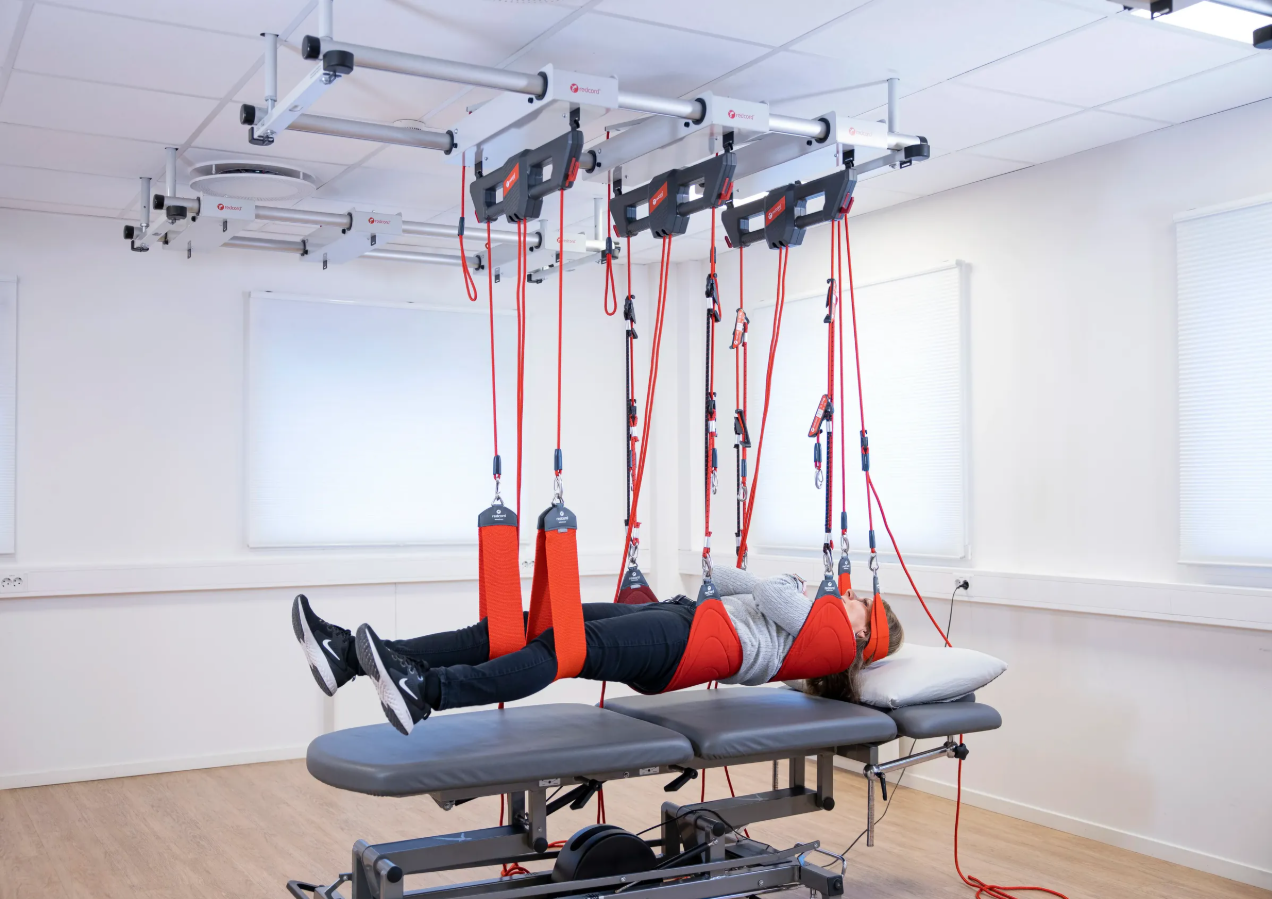
The Redcord system uses ropes, slings and adjustable suspension to partially support the body or individual limbs during exercise. The therapist can therefore make a movement easier when necessary and progressively increase the demand as control and strength improve.
This creates an unusually flexible rehabilitation environment.
For one patient, the slings may provide significant support while practising a movement. For another, the same system can introduce carefully controlled instability to challenge balance, trunk control and coordinated muscle activation.
Exercises can therefore be adapted to the individual’s strength, balance, mobility and stage of rehabilitation.
Why may this be relevant to Parkinson’s disease?
1. Balance and postural control
Impaired balance and reduced postural reactions are common in Parkinson’s disease and can contribute to difficulty turning, changing direction, negotiating obstacles and recovering from a loss of balance.
Redcord can allow the therapist to introduce controlled balance challenges while adjusting the amount of physical support provided.
Exercises may include:
– controlled weight shifting
– reaching
– changing the base of support
– supported single-leg loading
– stepping
– directional movement
– trunk control
– transitions between positions
The objective is not simply to make an exercise difficult. The objective is to provide enough challenge to stimulate adaptation while maintaining appropriate movement quality and safety.
This approach is consistent with current Parkinson’s rehabilitation evidence. Clinical practice guidelines strongly recommend balance training for people with Parkinson’s disease who have impaired postural control, balance or mobility.[1–3]
2. Core and trunk control
Parkinson’s can affect trunk mobility and the ability to efficiently control the body over the legs.
This matters because trunk control contributes to:
– upright posture
– balance
– turning
– reaching
– transfers
– walking
– changing direction
Redcord provides many ways of progressively training the abdominal, spinal, pelvic and hip musculature while altering the amount of body weight being supported.
Importantly, core rehabilitation itself has been investigated specifically in Parkinson’s disease.
In a randomised controlled trial involving 44 people with Parkinson’s disease, Cabrera-Martos and colleagues compared an eight-week core-stability programme with more general mobility, stretching and coordination exercises.
The core-training group demonstrated significantly greater improvements in dynamic balance measured with the Mini-BESTest as well as improvements in balance confidence and limits of stability.[4]
These findings provide a particularly relevant rationale for incorporating appropriately selected trunk and proximal-control exercises into Parkinson’s rehabilitation.
3. Functional strength
Reduced strength can make everyday tasks progressively more demanding.
Rather than isolating individual muscles, Redcord can be used to incorporate strength into functional movement patterns.
Examples may include progressively training:
– sit-to-stand movements
– hip extension
– hip abductor control
– knee control
– pushing and pulling movements
– supported squatting
– stepping
– trunk stabilisation during arm or leg movement
The amount of body weight supported by the Redcord slings can be altered, making an exercise easier initially and progressively more demanding as function improves.
Current Parkinson’s physiotherapy guidelines strongly support appropriately prescribed resistance training for maintaining or improving strength, power and functional ability.[2]
4. Walking, weight transfer and stepping
Walking is a complex interaction between balance, trunk control, leg strength, rhythm, coordination and the ability to transfer body weight from one side to the other.
A Redcord programme can therefore incorporate preparatory exercises addressing:
– left-to-right weight transfer
– forward and backward weight transfer
– stepping initiation
– hip and pelvic control
– trunk rotation
– lower-limb coordination
– movement amplitude
– balance during changing directions
These exercises do not replace gait training. They can be used alongside gait training as part of a broader rehabilitation programme.
Evidence-based Parkinson’s physiotherapy guidelines strongly recommend gait training and task-specific exercise to improve walking and functional mobility.[2]
5. Graded assistance and movement confidence
Some people with Parkinson’s may be physically capable of a movement but become apprehensive when balance is challenged.
Suspension allows the therapist to modify the level of support while movement is practised.
As control improves, assistance can gradually be reduced.
This can be particularly useful for people who require an intermediate stage between highly supported exercise and completely unsupported functional exercise.
6. Individualisation
Parkinson’s disease does not affect everybody in the same way.
One person may primarily experience rigidity and reduced trunk movement. Another may have difficulty with balance and turning. Another may experience reduced strength, freezing, reduced movement amplitude or difficulty transferring from sitting to standing.
For this reason, a Redcord programme should not consist of a standard set of exercises given to every Parkinson’s patient.
Treatment is based on assessment and may address different combinations of:
– balance
– posture
– strength
– mobility
– trunk control
– stepping
– gait preparation
– movement coordination
– functional activities
What does the research say about Redcord and Parkinson’s disease?
Direct research specifically examining Redcord in Parkinson’s disease is still limited.
However, a Parkinson’s-specific case report published in the Formosan Journal of Physical Therapy in 2023 described a 66-year-old man with Hoehn & Yahr stage III Parkinson’s disease who undertook Redcord suspension exercise for four weeks, twice weekly for one hour.[5]
The programme incorporated core stability, lower-limb coordination and movement control together with other rehabilitation components.
Following the programme, the authors reported changes including:
– Berg Balance Scale: 35 to 45
– Dynamic Gait Index: 16 to 20
– UPDRS Part III motor score: 26 to 15
– Barthel Index: 60 to 75
– Timed Up and Go: 8.9 to 7.5 seconds
– 30-second chair stand: 9 to 11 repetitions
The authors concluded that clinically meaningful improvements had occurred in several measures of balance, gait and motor performance.
This is encouraging but should be interpreted appropriately: it was a case report involving one patient rather than a controlled clinical trial. It therefore demonstrates clinical feasibility and provides preliminary evidence rather than establishing that Redcord is superior to other forms of Parkinson’s rehabilitation.
What does the wider Parkinson’s research show?
The broader evidence supporting targeted exercise and physiotherapy for Parkinson’s disease is much stronger.
A major 2026 systematic review and dose-response meta-analysis analysed 30 studies involving 2,932 people with Parkinson’s disease. Physiotherapy produced moderate improvements in balance, with balance-specific programmes demonstrating particularly favourable results.[6]
The American Physical Therapy Association clinical practice guideline gives strong recommendations for:
– balance training
– resistance training
– gait training
– task-specific training
– aerobic exercise
– external cueing
– community-based exercise
in appropriate people with Parkinson’s disease.[2]
NICE guidance in the UK specifically recommends Parkinson’s disease-specific physiotherapy for people experiencing balance or motor-function problems.[1]
A large Cochrane review involving 156 studies and 7,939 participants also concluded that many different types of structured physical exercise can have beneficial effects on motor symptoms and quality of life in Parkinson’s disease.[7]
Evidence from neurological rehabilitation using sling exercise
Redcord and related sling-exercise approaches have also been studied in neurological rehabilitation outside Parkinson’s disease.
A 2022 systematic review and meta-analysis included 25 randomised trials involving 1,504 people undergoing post-stroke rehabilitation. Sling exercise therapy produced improvements in several measures of walking ability, including walking speed, Timed Up and Go, step length and functional ambulation.[8]
A separate controlled study investigated the NEURAC method in people with post-stroke hemiplegia and reported improvements in balance, mobility and functional measurements.[9]
Stroke and Parkinson’s disease are very different neurological conditions, so these findings cannot automatically be transferred to Parkinson’s disease. They do, however, demonstrate that sling-based neuromuscular rehabilitation has been investigated within neurological rehabilitation and not only for musculoskeletal problems such as back pain.
What might a Parkinson’s Redcord programme involve?
The programme will depend on the initial assessment, but rehabilitation may progressively incorporate:
– supported trunk and core exercises
– hip and pelvic stability
– lower-limb strengthening
– supported standing exercises
– weight-shifting activities
– stepping and reaching
– functional sit-to-stand training
– coordination exercises
– rotational movement
– gait-preparation exercises
– balance challenges
– movement-amplitude exercises
– task-specific functional activities
Difficulty can be altered by changing body position, lever length, sling support, resistance, stability and the complexity of the movement.
Progress is therefore based on the individual rather than following a predetermined exercise routine.
Assessment first
Before beginning treatment, we assess the patient’s current functional abilities and determine which areas are appropriate to address.
Depending on the individual, this may include assessment of:
– balance
– walking
– posture
– transfers
– trunk control
– lower-limb strength
– coordination
– functional movement
– falls history
– confidence during movement
People with Parkinson’s may also have other factors that need to be considered, including freezing, dizziness or postural hypotension, osteoporosis, cardiovascular conditions, joint problems or significant fluctuations in mobility.
The programme is therefore modified according to the individual patient’s clinical circumstances.
Redcord as part of Parkinson’s rehabilitation
Current evidence strongly supports exercise and Parkinson’s-specific physiotherapy.
Evidence specifically for Redcord in Parkinson’s remains preliminary, but its ability to provide graded assistance, progressive resistance, controlled instability and individually selected neuromuscular exercises makes it a potentially useful rehabilitation tool for addressing many of the movement problems associated with Parkinson’s disease.
It is best considered as one component of a broader, individualised rehabilitation strategy rather than a stand-alone treatment for Parkinson’s itself.
Would you like to be assessed?
If Parkinson’s disease is affecting your balance, posture, strength, walking, transfers or confidence with movement, we can assess whether Redcord NEURAC rehabilitation may be suitable as part of your physiotherapy programme.
Contact The Back Pain Centre to arrange an initial assessment.
—
Research and clinical guidance
1. National Institute for Health and Care Excellence (NICE). Parkinson’s disease in adults. NICE Guideline NG71. Recommendation 1.7.3: Parkinson’s disease-specific physiotherapy for people experiencing balance or motor-function problems.
2. Osborne JA, Botkin R, Colon-Semenza C, et al. Physical Therapist Management of Parkinson Disease: A Clinical Practice Guideline From the American Physical Therapy Association. Physical Therapy. 2022;102(4):pzab302. DOI: 10.1093/ptj/pzab302.
3. States RA, Dewan B, Lynam P, Mensah N, Pottorf O. Group exercise for balance in people with Parkinson’s disease: a systematic review with meta-analysis. Physiotherapy Theory and Practice. 2025;41(4):872–889.
4. Cabrera-Martos I, Jiménez-Martín AT, López-López L, Rodríguez-Torres J, Ortiz-Rubio A, Valenza MC. Effects of a core stabilization training program on balance ability in persons with Parkinson’s disease: a randomized controlled trial. Clinical Rehabilitation. 2020;34(6):764–772. DOI: 10.1177/0269215520918631.
5. Chiang LC, Ting CW, Yeh PC. Effects of Redcord Suspension Exercise on Senior Fitness and Lower Extremity Function in Parkinson Disease: A Case Report. Formosan Journal of Physical Therapy. 2023;48(2). Abstract P32. DOI: 10.6215/FJPT.202306.P32.
6. Cardini R, Gervasoni E, Giannoni-Luza S, et al. Physiotherapy interventions for balance impairments in Parkinson’s disease: evidence from a systematic review and dose-response meta-analysis. npj Parkinson’s Disease. 2026;12:118. DOI: 10.1038/s41531-026-01326-7.
7. Ernst M, Folkerts AK, Gollan R, et al. Physical exercise for people with Parkinson’s disease: a systematic review and network meta-analysis. Cochrane Database of Systematic Reviews. Updated 2024. DOI: 10.1002/14651858.CD013856.pub3.
8. Long J, Zhang Y, Liu X, Jin X. Effects of sling exercise therapy on post-stroke walking impairment: a systematic review and meta-analysis. International Journal of Rehabilitation Research. 2022;45(1):12–23. DOI: 10.1097/MRR.0000000000000505.
9. Wang J, Wang S, Wu H, Dong S, Zhang B. Muscle Energy Technique plus Neurac Method in Stroke Patients with Hemiplegia Complicated by Diabetes Mellitus and Assessment of Quality of Life. Disease Markers. 2022;2022:6318721. DOI: 10.1155/2022/6318721.