
- April 3, 2026
- Clinic Director
- Comment: 0
- News
When patients think about recovery—whether from back pain, disc issues, tendon strain, or general wear and tear—collagen often comes up. It is essential for joints, ligaments, discs, and skin.
For Vegetarians – scroll down!
However, most information online focuses on the wrong things. This article explains, in simple terms, what actually matters for your body to repair and rebuild collagen effectively.
Why Collagen Matters in Chiropractic Care
Your spine, joints, and soft tissues rely heavily on collagen:
- Ligaments (stability of the spine)
- Tendons (movement and strength)
- Intervertebral discs (shock absorption)
- Cartilage (joint protection)
When collagen quality declines, tissues become:
- Stiffer
- Weaker
- More prone to injury
This is why supporting collagen production is important alongside chiropractic treatment and rehabilitation.
You Don’t Absorb Collagen as Collagen
Collagen is a large, tightly wound protein. Your body cannot absorb it in that form.
To become usable, it must be:
- Unwound (denatured)
- Broken down (hydrolysed) into smaller pieces called peptides
This is why supplements use hydrolysed collagen (collagen peptides).
After you take it:
- Peptides are broken down further into amino acids
- These enter your bloodstream
At this point, your body simply sees building blocks, not “collagen from a specific source.”
“Types” and “Sources” Are Not the Key Factor
You may hear about:
- Marine vs bovine collagen
- Type I, II, or III collagen
In reality:
- All collagen is broken down during digestion
- The body does not direct “Type II to joints” or “Type I to skin”
These distinctions matter in anatomy—but not in how supplements work inside your body.
The Real Limiting Factor: Glycine
Here is the most important point:
- About one-third of your collagen is made of glycine
- Glycine is often lacking in modern diets
This means:
Even if you take collagen, your body may not be able to rebuild new tissue properly if glycine is insufficient.
Why this matters for recovery
Low glycine can lead to:
- Slower healing of ligaments and tendons
- Reduced tissue repair after adjustments
- Older, stiffer collagen remaining in place
Your body prioritises survival functions first. If glycine is limited, collagen repair is not prioritised.
Why Collagen Alone May Not Be Enough
A typical serving of collagen provides:
- ~3–4g of glycine
But many people need:
- 8–10g per day
- More during:
- Injury recovery
- Chronic pain
- High physical activity
This creates a gap between what you take and what your body actually needs.
Collagen Turnover: Keeping Tissue Young and Functional
Healthy tissue is not just about having collagen—it is about renewing it.
If glycine intake is low:
- Old collagen is not replaced efficiently
- Tissue becomes:
- Less elastic
- More fragile
- More prone to irritation and injury
Supporting collagen turnover is key for long-term spinal and joint health.
Additional Benefit: Glycine and Sleep
Glycine also supports:
- Relaxation of the nervous system
- Better sleep quality
- Reduced mental overactivity
Good sleep is essential for healing and recovery, making glycine particularly useful in the evening.
Practical Options for Supplementation
There are two simple and effective ways to support collagen production:
Option 1
Hydrolysed collagen combined with extra glycine
- Provides both collagen peptides and sufficient glycine
- Naturally tastes slightly sweet (glycine has a sweet taste despite no sugar)
- Can be mixed in water and sipped during the day
Option 2
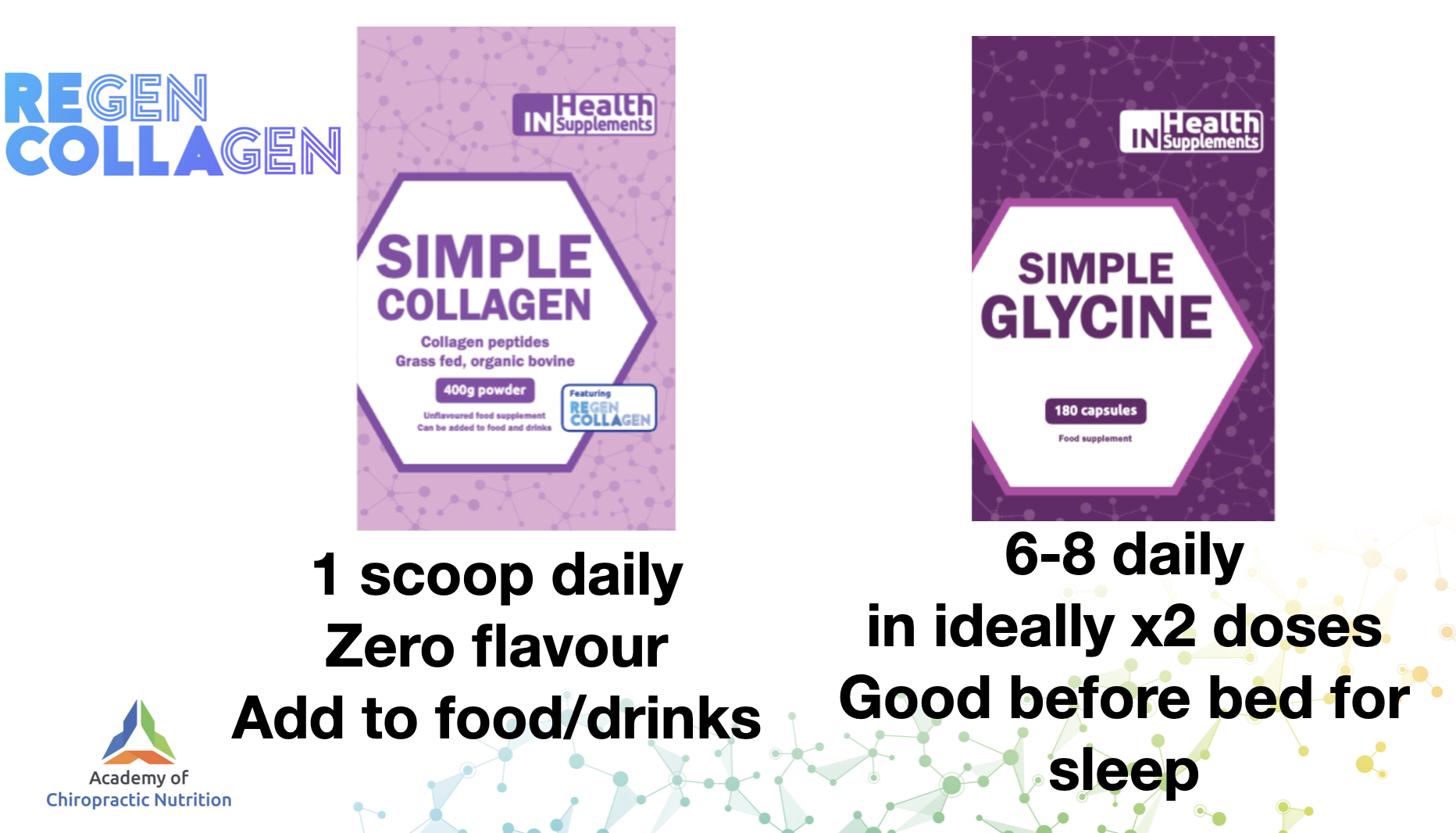
Simple hydrolysed collagen + separate glycine capsules
- No sweet taste
- Flexible dosing of glycine
- Convenient for evening use (especially before sleep)
Best Collagen “Tried and Tested” by us:
We use Collagen made by IN Health Supplements – Grass Fed Bovine Hydrolised Collagen with extra Glycine and Vitamin C or Plain Collagen and a separate helping of Glycine Capsules.
InHealth Supplements can be purchased at the clinic
or online: register* under Vasilijs Maslukovs The Back Pain Centre
*this registration is designed to allocate you to the clinician, who can advice you on the quality and quantity of supplements from this brand ecause they have ACTIVE INGREDIENTS in HIGH DOSES
Key Takeaway
Collagen support is not about choosing the “best type” or “best source.”
It is about giving your body the right building blocks, especially glycine, so it can repair and maintain strong, healthy tissues.
This is particularly important when recovering from injury, managing pain, or improving long-term spinal health alongside chiropractic care.
Vegetarian Collagen: What Are Your Real Options?
For vegetarians, it is important to understand that true collagen supplements are not vegetarian, as collagen is naturally derived from animal tissue.
However, there are effective plant-based alternatives known as collagen-building formulas.
These do not contain collagen itself but provide the key nutrients your body needs to produce its own — including amino acids such as glycine and proline, along with essential cofactors like vitamin C, zinc and copper.
High-quality formulations, such as Viridian Collagen Pro Factors or Cytoplan Vegan Collagen, are designed to mirror the amino acid profile of human collagen and support connective tissue, skin, joints and recovery.
While they work through a different mechanism than traditional collagen peptides, they offer a practical and evidence-informed approach for vegetarians looking to support healing, repair and overall structural health.
You can browse these options on Amazon:

- Chiropractor with own car park and X-ray on site, 5 minutes walk from the nearest tube, Central line, serving most of East London and Essex, only 20 minutes from Stratford and 40 minutes from central London.
- 02089893338
- 07874306269
- reception@nobackpaincentre.com